Let's Get That Pending Article Published To The World
For Adverts and Enquiries
Phone: 234 903 352 3975
Email: triplenetblogs@gmail.com

Let's Get That Pending Article Published To The World
For Adverts and Enquiries
Phone: 234 903 352 3975
Email: triplenetblogs@gmail.com





It has become a recurring expression among members of the Law Officers Association of Nigeria (LOAN) to refer to members of the Magistrates Association of Nigeria (MAN) as their “counterparts.” This repeated description calls for some clarification.
The pertinent question is: Are Magistrates, in law and in institutional function, truly the counterparts of Law Officers?
To properly address this question, it is necessary, first, to consider the ordinary meaning of the word “counterpart.”
Meaning of “Counterpart”
The Cambridge English Dictionary defines counterpart as a person or thing that has the same purpose, position or function as another person or thing in a different place or organisation. Merriam-Webster similarly describes a counterpart as a person or thing that closely corresponds to another, while Oxford Learner’s Dictionaries defines it as a person or thing having the same position or function as another in a different place or situation.
The common thread running through these definitions is clear: a counterpart is ordinarily someone occupying a corresponding position, performing a substantially similar function or holding an equivalent role in another organisation or setting.
It therefore becomes necessary to examine the respective offices of a Magistrate and a Law Officer.
WHO IS A MAGISTRATE?
A Magistrate is a judicial officer who exercises judicial functions in a Magistrates’ Court established under the applicable law of the relevant State or the Federal Capital Territory.
The Constitution recognises the judicial powers of the Federation and of the States and provides for the establishment of courts by law. The precise structure, appointment, powers and jurisdiction of Magistrates are consequently governed substantially by the relevant State legislation.
A Magistrate does not represent the Government, the Attorney-General or any litigant before the court. Rather, the Magistrate sits as an impartial judicial officer and adjudicates disputes and criminal proceedings brought before the court, subject to the jurisdiction conferred by law.
The essential character of the office is therefore judicial and adjudicatory.
WHO IS A LAW OFFICER?
The Law Officers Act expressly creates the offices of Attorney-General, Solicitor-General and State Counsel. It further provides that specified law officers, including State Counsel, are deemed to be barristers, advocates and solicitors of the Supreme Court ex officio and are entitled to appear as counsel in courts in Nigeria where counsel may appear.
A Law Officer or State Counsel therefore performs a fundamentally different function from that of a Magistrate. A State Counsel is a legal practitioner serving the Government and, depending on the office and assignment, may advise the Government, prosecute criminal proceedings, represent the Government in civil proceedings, undertake legal drafting and perform other functions assigned within the Ministry of Justice.
The distinction is also reflected in legislation governing representation of government in court, which recognises representation by a law officer, State Counsel or another duly authorised legal practitioner.
The essential character of the Law Officer's role is therefore legal representation, prosecution, legal advice or other professional legal service on behalf of government, rather than adjudication.
THE FUNDAMENTAL INSTITUTIONAL DISTINCTION
This is where the issue of “counterpart” becomes important.
Magistrates are judicial officers and form part of the Judiciary. Law Officers and State Counsel, on the other hand, ordinarily serve within the Ministry of Justice under the authority of the Attorney-General and Commissioner for Justice, which is an institution of the Executive arm of government.
The distinction is not merely semantic. It goes to the very nature of their constitutional and professional functions.
A Magistrate sits in judgment over matters brought before the court. A Law Officer may appear before that court as counsel representing the State or another government interest. Indeed, it is not unusual for State Counsel to appear before Magistrates in the discharge of their professional duties.
One occupies the adjudicatory side of the administration of justice; the other performs the functions of a legal practitioner representing or advising government.
Accordingly, while both are members of the broader justice system and both undoubtedly play important roles in the administration of justice, their offices are neither identical nor institutionally corresponding in the sense ordinarily conveyed by the word “counterpart.”
THE ISSUE OF SALARY AND CONDITIONS OF SERVICE
It is no longer news that the Law Officers Association of Nigeria (LOAN), Kwara State Chapter, has been advocating for the implementation of salary, allowances and conditions of service that would bring the remuneration of State Counsel in line with that of Magistrates.
There is nothing objectionable in Law Officers seeking improved remuneration, better working conditions and the implementation of any legitimate entitlement due to them. That is a legitimate professional and industrial concern.
The issue addressed here is entirely different.
A demand for salary harmonisation does not, by itself, make two offices counterparts.
Remuneration may be compared for policy, administrative or industrial reasons without implying that the offices being compared perform the same constitutional, judicial or professional functions.
Consequently, the fact that the remuneration or conditions of service of Magistrates may be used as a benchmark for determining those of State Counsel does not necessarily establish that Magistrates and Law Officers are institutional counterparts.
A WORD TO OUR COLLEAGUES
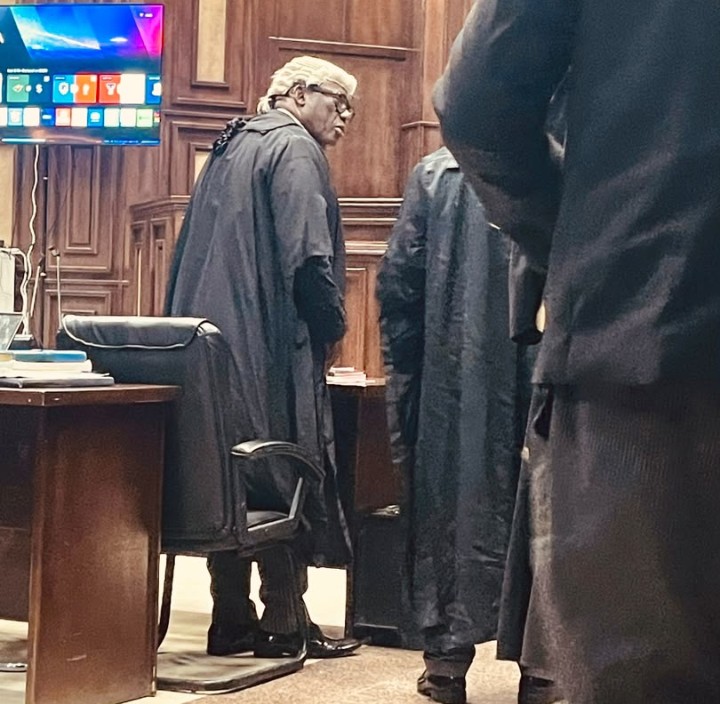
It is also noteworthy that the same description was
used by the Chairman of the Ilorin Branch of the Nigerian Bar Association while advocating the demands of LOAN at the recently concluded 2026/2027 Legal Year ceremony.
The reaction of many Magistrates present was noticeable. However, rather than allowing such descriptions to continue without clarification, it is appropriate for the Magistrates Association of Nigeria to make its position known in a professional and constructive manner.
Our silence should not be misconstrued as acceptance of a description that does not accurately reflect the nature of our respective offices.
Magistrates are not legal practitioners appearing before the court in their professional capacity. They are judicial officers entrusted with the responsibility of adjudicating matters before them. Law Officers and State Counsel are legal practitioners who, among other functions, may appear before Magistrates in the discharge of their professional duties.
The distinction is fundamental.
CONCLUSION
There is absolutely no need to diminish the status or legitimate aspirations of Law Officers in order to preserve the distinct identity of the Magistracy. Law Officers deserve appropriate remuneration, professional recognition and conducive conditions of service. At the same time, the distinct nature of judicial office must be properly understood and respected.
The issue, therefore, is not one of superiority or inferiority. It is one of institutional identity, constitutional function and professional role.
Magistrates and Law Officers occupy important but fundamentally different positions within the administration of justice. One is a judicial officer whose duty is to adjudicate impartially; the other is a legal practitioner who serves and represents government within the scope of the law.
For that reason, the repeated description of Magistrates as the “counterparts” of Law Officers is, at the very least, misleading when used to suggest that the two offices are equivalent or perform corresponding functions.
The distinction deserves to be clearly understood and appropriately maintained.
Magistrates are Magistrates. Law Officers are Law Officers. Their respective offices, functions and institutional identities should not be conflated.
AbdulGaniyu Ajia
Senior Magistrate
From the Kwara State Judiciary.
October, 2026





 12247
©www.triplenet.com.ng/lawparliament
All right Reserved